Table of Contents
Toggle10 SEO Mistakes That Are Killing Your Website Rankings (2026 Guide)
If your website is not getting enough organic traffic, struggling to rank on Google, or losing visibility after algorithm updates, you may be making SEO mistakes without even realizing it. Many business owners spend thousands of rupees on website development and digital marketing but overlook the small optimization issues that have the biggest impact on rankings.
In 2026, Google’s ranking systems are smarter than ever. They evaluate content quality, user experience, website speed, mobile usability, search intent, technical SEO, and trust signals before deciding where a page should appear in search results. Even a well-designed website can struggle if it contains Common SEO Mistakes that reduce its relevance and usability.
This guide explains the 10 SEO Mistakes That Are Killing Your Website Rankings, why they matter, and how you can fix them using practical, beginner-friendly strategies. Whether you own a startup, an eCommerce business, or a local company, avoiding these Website SEO Errors can help improve visibility, attract qualified visitors, and support long-term growth.
At MB Digital Studio, we regularly perform SEO audits for businesses across different industries. One pattern we consistently see is that websites often don’t fail because of a lack of effort—they fail because essential SEO fundamentals are overlooked. Fixing these issues can significantly improve your chances of ranking higher and delivering a better experience to users.
Why It Matters in 2026
SEO is no longer about adding keywords to a page. Search engines now prioritize websites that provide valuable, trustworthy, and user-focused content.
In 2026, successful SEO depends on several factors working together:
- High-quality, original content
- Fast-loading pages
- Mobile-friendly design
- Clear website structure
- Helpful answers to user questions
- Strong technical SEO
- Positive user experience
- Trustworthy information backed by expertise
Ignoring these factors can make it difficult for search engines to understand and rank your website, even if you publish content regularly.
Businesses that fix SEO Mistakes to Avoid often see improvements in organic traffic, user engagement, and conversions over time.
Mistake 1: Ignoring Search Intent
What is Search Intent?
Search intent is the purpose behind a user’s search query. Every time someone searches on Google, they expect results that directly answer their question or solve their problem.
For example:
- Someone searching “What is SEO?” wants educational information.
- Someone searching “Best SEO Agency in Ahmedabad” wants to compare service providers.
- Someone searching “Buy SEO tools” is ready to make a purchase.
If your content does not match the user’s intent, Google is less likely to rank it.
Why It Hurts Rankings
Many businesses focus only on inserting keywords instead of creating content that answers users’ questions. This is one of the Common SEO Mistakes that reduces engagement and increases bounce rates.
Google measures whether users find your content useful. If visitors leave quickly because the content doesn’t meet their expectations, rankings can suffer.
How to Fix It
- Understand what users want before writing content.
- Review the top-ranking pages for your target keyword.
- Match your content format to the search intent.
- Answer important questions early in the article.
- Use clear headings and simple language.
Pro Tip: Before publishing a page, ask yourself: “Does this content fully answer the user’s question?” If the answer is yes, you’re moving in the right direction.
Mistake 2: Poor Keyword Research
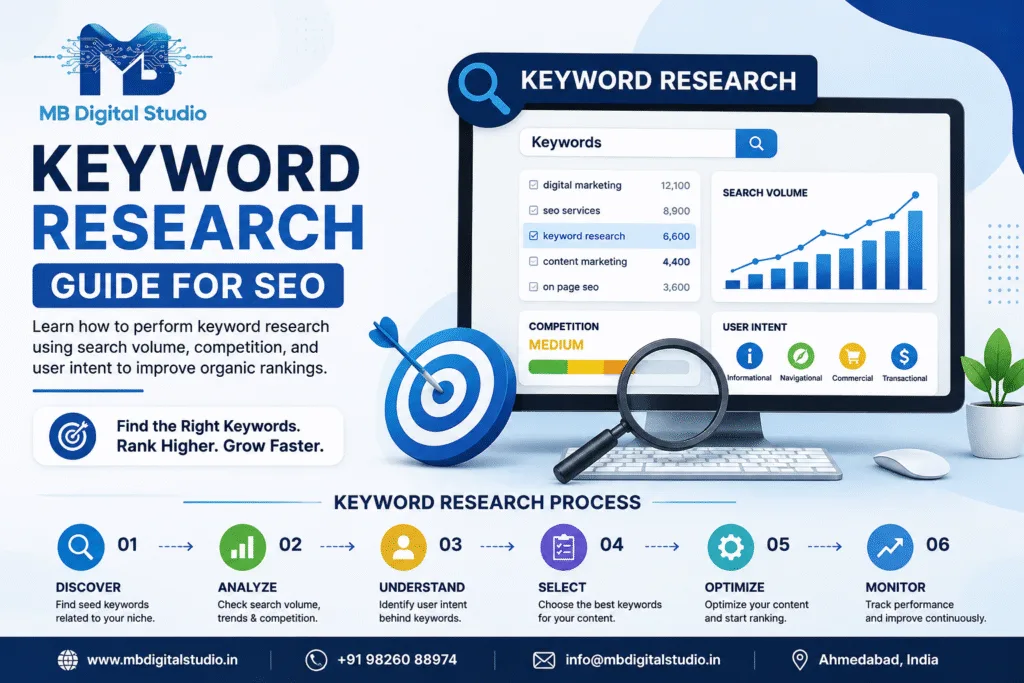
Keyword research is the foundation of every successful SEO strategy. Choosing keywords without understanding search intent, competition, or relevance often leads to poor rankings and low-quality traffic.
Many websites either target highly competitive keywords that are difficult to rank for or focus on terms that their audience rarely searches.
Common Keyword Research Mistakes
- Targeting only high-volume keywords.
- Ignoring long-tail keywords.
- Using outdated keyword data.
- Not researching competitors.
- Stuffing the same keyword repeatedly.
These Website SEO Errors make it harder for search engines to understand your content and reduce the chances of attracting the right audience.
How to Fix It
Use reliable tools such as:
- Google Search Console
- Google Keyword Planner
- Semrush
- Ahrefs
When selecting keywords:
- Focus on relevance instead of just search volume.
- Include long-tail and question-based keywords.
- Use related terms naturally throughout your content.
- Review search intent before creating a page.
A well-planned keyword strategy improves both rankings and user satisfaction.
Mistake 3: Missing or Weak Meta Titles and Meta Descriptions
Meta titles and meta descriptions are often the first things users see in search results. They influence whether someone clicks on your page or chooses another result.
Weak, duplicated, or missing metadata is one of the most overlooked SEO Mistakes to Avoid.
Why It Hurts Rankings
Although meta descriptions are not a direct ranking factor, compelling metadata can improve click-through rates, which supports overall search performance.
Poor metadata can also make it difficult for search engines and users to understand what your page is about.
Best Practices
- Write a unique title for every page.
- Keep titles between 50–60 characters.
- Keep meta descriptions around 150–160 characters.
- Include the primary keyword naturally.
- Make your copy informative and engaging.
Example
Meta Title:
10 SEO Mistakes That Are Killing Your Website Rankings (2026 Guide)
Meta Description:
Learn the most common SEO mistakes that reduce Google rankings and discover practical tips to improve your website’s visibility and organic traffic.
Key Takeaways
- Always create content that matches search intent.
- Perform thorough keyword research before writing.
- Use clear, compelling meta titles and descriptions.
- Focus on helping users first, then optimize for search engines.
- Fixing these foundational issues builds a stronger SEO strategy.
10 SEO Mistakes That Are Killing Your Website Rankings (2026 Guide)
Mistake 4: Slow Website Speed
A slow website creates a poor user experience, increases bounce rates, and can negatively affect your search visibility. Improving page speed is one of the easiest ways to improve website rankings and user satisfaction.
Website speed has become a major ranking signal because users expect pages to load quickly. Research consistently shows that visitors are more likely to leave a website if it takes too long to load. This means you could lose potential customers before they even view your products or services.
At MB Digital Studio, website speed is one of the first things we check during an SEO audit because it directly impacts both user experience and conversions.
Common Causes of Slow Websites
- Large, uncompressed images
- Too many plugins or scripts
- Poor-quality web hosting
- Heavy CSS and JavaScript files
- No browser caching
- Unoptimized databases
How to Fix It
- Compress images using WebP format.
- Enable browser caching.
- Minify CSS and JavaScript files.
- Use a Content Delivery Network (CDN).
- Choose reliable hosting.
- Remove unnecessary plugins.
Pro Tip
Use Google PageSpeed Insights and Google Lighthouse regularly to identify performance issues and prioritize improvements.
Mistake 5: Poor Mobile Optimization
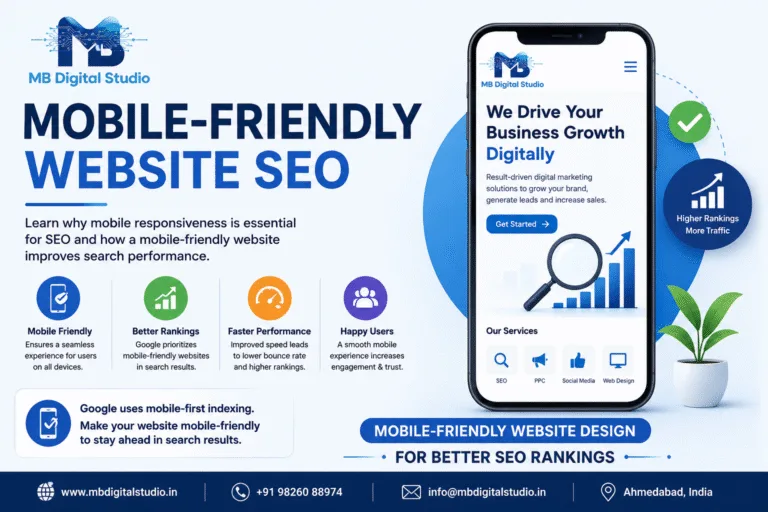
If your website isn’t mobile-friendly, you’re likely losing rankings and potential customers. Google primarily uses the mobile version of a website for indexing and ranking.
Today, a significant share of searches comes from smartphones. A website that looks great on a desktop but performs poorly on mobile can create a frustrating experience for users.
This is one of the most common SEO Mistakes to Avoid because mobile usability affects both rankings and conversions.
Signs Your Website Isn’t Mobile Friendly
- Small text that’s difficult to read
- Buttons placed too close together
- Slow loading on mobile devices
- Images that don’t resize properly
- Horizontal scrolling
- Pop-ups covering the content
How to Fix It
- Use a responsive website design.
- Test your website on multiple screen sizes.
- Improve loading speed for mobile users.
- Make navigation simple and touch-friendly.
- Use readable fonts and sufficient spacing.
Why It Matters
A mobile-friendly website improves user engagement, lowers bounce rates, and supports stronger SEO performance.
Mistake 6: Thin or Duplicate Content
Publishing low-value, copied, or repetitive content makes it difficult for search engines to understand which page deserves to rank. Creating original, helpful content is essential for long-term SEO success.
Google rewards websites that provide unique, accurate, and useful information. Pages with very little content or duplicate text often struggle to perform well in search results.
These Website SEO Errors are especially common on eCommerce websites with copied product descriptions or blogs that repeat similar information.
Examples of Thin Content
- Pages with only a few sentences
- Duplicate service pages
- AI-generated content without editing
- Repetitive blog posts
- Empty category pages
How to Fix It
- Write original, people-first content.
- Answer user questions in detail.
- Update older articles with new information.
- Remove duplicate pages where appropriate.
- Add examples, tables, images, and FAQs.
MB Digital Studio Recommendation
Every blog should solve a real problem instead of simply targeting a keyword. Valuable content earns trust, attracts backlinks, and performs better over time.
Mistake 7: Weak Internal Linking
Quick Answer
Internal links help search engines discover your pages, understand your website structure, and guide visitors to related content. Without a clear internal linking strategy, valuable pages may receive less visibility.
Many websites publish excellent articles but never connect them to other relevant pages. This reduces crawl efficiency and makes it harder for users to continue exploring the site.
Among the Common SEO Mistakes, weak internal linking is often overlooked despite being easy to fix.
Benefits of Internal Linking
- Helps search engines crawl your website
- Passes authority between related pages
- Improves user navigation
- Increases average session duration
- Reduces bounce rate
- Supports topic clusters and content hierarchy
Best Practices
- Link to related service pages naturally.
- Use descriptive anchor text.
- Avoid excessive links on a single page.
- Update older blogs with links to newer content.
- Create pillar pages connected to supporting articles.
Example Internal Links for MB Digital Studio
If you’re publishing this article on the MB Digital Studio website, you can naturally link it to:
- SEO Services
- Technical SEO Services
- Local SEO Services
- Digital Marketing Services
- Website Development Services
- Google Ads Services
- Benefits of AI in Digital Marketing
- Why Ahmedabad SMEs Are Hiring Digital Marketing Agencies
These links improve website structure while helping readers discover more useful content.
Comparison Table: Good SEO vs Common SEO Mistakes
SEO Best Practice | Common SEO Mistake | Impact |
Fast-loading website | Slow page speed | Higher bounce rate |
Responsive design | Poor mobile experience | Lower rankings |
Original, valuable content | Thin or duplicate content | Reduced visibility |
Strong internal linking | No linking strategy | Poor crawlability |
Optimized images | Large image files | Slower loading |
Helpful content | Keyword stuffing | Poor user experience |
Mistake 8: Ignoring Technical SEO
Technical SEO ensures that search engines can crawl, index, and understand your website correctly. Even the best content may struggle to rank if technical SEO issues prevent Google from accessing your pages.
Many businesses invest in content creation but ignore the technical foundation of their websites. This is one of the 10 SEO Mistakes That Are Killing Your Website Rankings because search engines need a healthy website structure before they can rank your content effectively.
At MB Digital Studio, every SEO project begins with a technical SEO audit to identify hidden issues affecting rankings.
Common Technical SEO Issues
- Broken links (404 errors)
- Missing XML sitemap
- Incorrect Robots.txt configuration
- Duplicate pages
- Missing canonical tags
- HTTPS security issues
- Poor Core Web Vitals
- Crawl and indexing errors
How to Fix It
- Submit an updated XML Sitemap in Google Search Console.
- Fix broken links and redirect outdated URLs.
- Use canonical tags to prevent duplicate content issues.
- Ensure your website uses HTTPS.
- Improve Core Web Vitals (LCP, CLS, INP).
- Regularly monitor indexing reports in Google Search Console.
Recommended Tools
- Google Search Console
- Google PageSpeed Insights
- Screaming Frog SEO Spider
- Semrush Site Audit
- Ahrefs Webmaster Tools
Pro Tip: Schedule a technical SEO audit every 3–6 months to identify issues before they impact your rankings.
Mistake 9: Building Low-Quality Backlinks
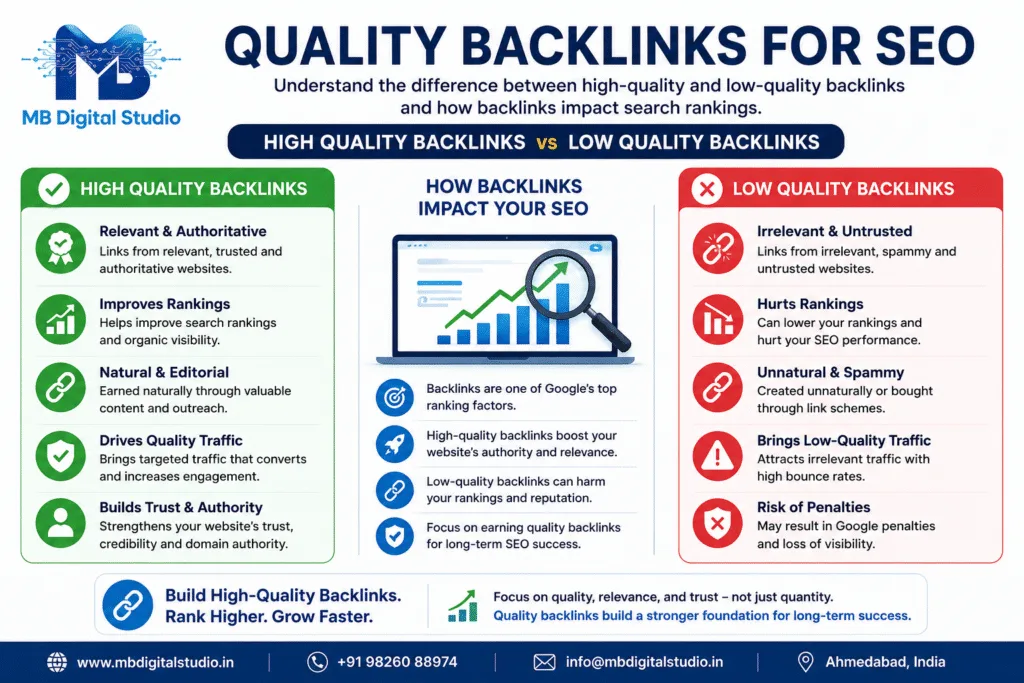
Backlinks remain an important ranking factor, but quality matters far more than quantity. A few authoritative backlinks are often more valuable than hundreds of low-quality links.
One of the biggest Website SEO Errors businesses make is purchasing backlinks from spammy websites or participating in link schemes. These tactics can damage your website’s reputation and, in some cases, lead to manual actions from Google.
Signs of Poor-Quality Backlinks
- Links from unrelated websites
- Spam directories
- Private Blog Networks (PBNs)
- Excessive exact-match anchor text
- Paid links without proper disclosure
How to Build High-Quality Backlinks
- Publish original research and useful resources.
- Create in-depth blog posts that others want to reference.
- Write guest articles on reputable industry websites.
- Earn mentions through digital PR.
- Build relationships with trusted businesses and industry publications.
Good vs Bad Backlinks
Good Backlinks | Bad Backlinks |
Relevant websites | Spam websites |
Industry blogs | Link farms |
News publications | PBNs |
Genuine editorial links | Paid spam links |
High authority websites | Low-quality directories |
At MB Digital Studio, we recommend earning backlinks through valuable content and ethical outreach instead of shortcuts that may harm long-term SEO performance.
Mistake 10: Never Updating Old Content
SEO is an ongoing process, not a one-time task. Content that performed well two years ago may no longer meet user expectations or reflect the latest information.
Google favors fresh, accurate, and helpful content. Updating older pages can improve rankings without creating entirely new articles.
Many websites lose traffic simply because they never revisit their existing content.
What Should You Update?
- Outdated statistics
- Broken internal and external links
- Old screenshots
- New industry trends
- Additional FAQs
- Recent examples and case studies
- New keywords and search intent
Benefits of Updating Content
- Better rankings
- Increased organic traffic
- Improved user experience
- Higher click-through rates
- Greater authority and trust
MB Digital Studio Tip: Review your most important blog posts every 6–12 months and update them with fresh insights, examples, and current SEO best practices.
Latest SEO Trends & Insights (2026)
SEO in 2026 is focused on creating people-first content supported by strong technical optimization and AI-friendly structure.
Key Trends
- Google AI Overview is changing how users discover information.
- Answer Engine Optimization (AEO) helps content appear in AI-generated responses.
- Generative Engine Optimization (GEO) improves visibility in AI tools such as ChatGPT and Gemini.
- Voice search continues to grow with conversational queries.
- Topic clusters and semantic SEO are replacing isolated keyword targeting.
- Core Web Vitals remain important for user experience.
- Structured data (Schema Markup) helps search engines understand content.
- E-E-A-T continues to influence content quality and trust.
Businesses that create useful, well-structured, and trustworthy content are better positioned to succeed in both traditional search engines and AI-powered search experiences.
Conclusion
SEO success is not about finding shortcuts—it’s about consistently following best practices and delivering value to users. The 10 SEO Mistakes That Are Killing Your Website Rankings discussed in this guide are among the most common reasons websites struggle to gain visibility on Google.
By aligning your content with search intent, improving technical SEO, publishing original content, optimizing for mobile users, earning high-quality backlinks, and regularly updating your pages, you can build a stronger foundation for sustainable organic growth.
Remember that SEO is an ongoing process. Search algorithms evolve, user behavior changes, and competitors continue to improve their websites. Businesses that review and refine their SEO strategy regularly are better positioned to achieve long-term success.
Whether you’re a startup, a local business, or an established brand, avoiding these common mistakes can help improve your rankings, attract more qualified visitors, and generate better business results.
Grow Your Business with MB Digital Studio
Looking to improve your website’s SEO and increase organic traffic?
MB Digital Studio offers customized SEO solutions designed to help businesses improve search visibility, attract qualified leads, and achieve measurable growth.
Our services include:
- SEO Audits
- Technical SEO
- On-Page SEO
- Local SEO
- Google Ads Management
- Social Media Marketing
- Content Marketing
- Website Development
- Performance Marketing
Whether you’re launching a new website or improving an existing one, our team can create a strategy tailored to your business goals.
📞 Contact MB Digital Studio today for a free SEO consultation and discover how a well-planned SEO strategy can help your business grow.
F.A.Q.
Supporting Subheading
The most common SEO mistakes include ignoring search intent, poor keyword research, slow website speed, duplicate content, weak internal linking, technical SEO issues, low-quality backlinks, and failing to update content regularly.
SEO mistakes make it difficult for Google to crawl, understand, and trust your website. They can reduce organic traffic, lower keyword rankings, and negatively impact user experience.
It is recommended to perform a complete SEO audit every 3 to 6 months. Regular audits help identify technical issues, content gaps, broken links, and performance problems before they affect your rankings.
Yes. Website speed is an important ranking factor and also affects user experience. Faster websites generally have lower bounce rates and better conversion rates.
No. Keyword stuffing is considered a poor SEO practice. Google rewards natural, user-focused content that answers search intent rather than repeating the same keyword excessively.
Search intent is the reason behind a user’s search query. Your content should match what the user wants to learn, compare, or purchase.
Mobile SEO is essential because Google primarily uses the mobile version of a website for indexing and ranking. A responsive, mobile-friendly website improves both user experience and search performance.
Some of the most trusted SEO tools include:
- Google Search Console
- Google Analytics
- Google PageSpeed Insights
- Semrush
- Ahrefs
- Screaming Frog SEO Spider
To improve rankings:
- Publish helpful content.
- Fix technical SEO issues.
- Improve page speed.
- Build quality backlinks.
- Optimize for mobile devices.
- Update older content.
- Create a strong internal linking structure.
Yes. High-quality backlinks from relevant and trusted websites remain an important ranking signal. Focus on earning links naturally rather than buying them.